
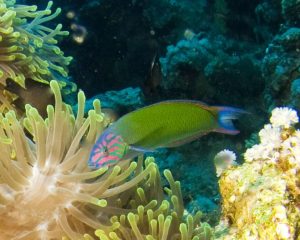
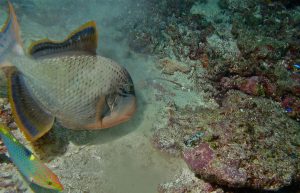
There are also those that follow other fish, almost like a shadow, watching closely to see what hidden treasures are revealed when these hunters are at work. Look out for the small checkerboard wrasse (Halichoeres hortulanus) hungrily tailing either a triggerfish upturning rocks or goatfish that is stirring up the sand in hope of nabbing a quick crab or clam. What would you call this- Clever? Lazy? Freeloading?
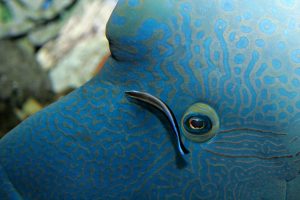
By virtue of their choice of cuisine, some wrasses play critical roles in the functioning of coral reefs as an ecosystem. I am talking about the unassuming but industrious blue-streaked cleaner wrasses (Labroides dimidiatus). Cleaner wrasses feed specifically on parasites, dead tissues and mucous, found on the bodies of fish that do not want to keep any of it. In the process, cleaner wrasses have set up some of the most phenomenal symbiotic relationships that can be observed while diving. These wrasses work in pairs or in small groups and work extremely hard to look for fish that are looking to be cleaned. A single cleaner wrasse on duty, working 4 continuous hours, cleans up to 2000 ‘client’ fish. Starting up and running a cleaning station successfully is no joke for these finger-sized fish and there is a lot that we can learn from observing them.
Of all the wrasses that we might come across commonly, we are likely to underestimate the anchor tuskfish (Choerodon anchorago) the most. The anchor tuskfish is named so for its tusk-like canines. These sharp teeth when unleashed, transform the otherwise delightful-looking wrasse into a predator that every hard-shelled animal should be afraid of! Tuskfish can spend hours trying to dig out clams, carry them over to specific spots on the reef, where they whack them repeatedly against specific rocks until the shells crack open and are ready for devouring. Tuskfish are the first wild fish to be documented using tools.
I would like to end this showcase with one of my favourite wrasses of them all. It is one that some of us have probably witnessed, doing something so bizarre, in a span of one second, that no one but you and the wrasse will believe that it happened. Ladies and gentlemen, I give you Epibulus insidiator or the slingjaw wrasse!
There are also those that follow other fish, almost like a shadow, watching closely to see what hidden treasures are revealed when these hunters are at work. Look out for the small checkerboard wrasse (Halichoeres hortulanus) hungrily tailing either a triggerfish upturning rocks or goatfish that is stirring up the sand in hope of nabbing a quick crab or clam. What would you call this- Clever? Lazy? Freeloading?
By virtue of their choice of cuisine, some wrasses play critical roles in the functioning of coral reefs as an ecosystem. I am talking about the unassuming but industrious blue-streaked cleaner wrasses (Labroides dimidiatus). Cleaner wrasses feed specifically on parasites, dead tissues and mucous, found on the bodies of fish that do not want to keep any of it. In the process, cleaner wrasses have set up some of the most phenomenal symbiotic relationships that can be observed while diving. These wrasses work in pairs or in small groups and work extremely hard to look for fish that are looking to be cleaned. A single cleaner wrasse on duty, working 4 continuous hours, cleans up to 2000 ‘client’ fish. Starting up and running a cleaning station successfully is no joke for these finger-sized fish and there is a lot that we can learn from observing them.
Of all the wrasses that we might come across commonly, we are likely to underestimate the anchor tuskfish (Choerodon anchorago) the most. The anchor tuskfish is named so for its tusk-like canines. These sharp teeth when unleashed, transform the otherwise delightful-looking wrasse into a predator that every hard-shelled animal should be afraid of! Tuskfish can spend hours trying to dig out clams, carry them over to specific spots on the reef, where they whack them repeatedly against specific rocks until the shells crack open and are ready for devouring. Tuskfish are the first wild fish to be documented using tools.
I would like to end this showcase with one of my favourite wrasses of them all. It is one that some of us have probably witnessed, doing something so bizarre, in a span of one second, that no one but you and the wrasse will believe that it happened. Ladies and gentlemen, I give you Epibulus insidiator or the slingjaw wrasse!