
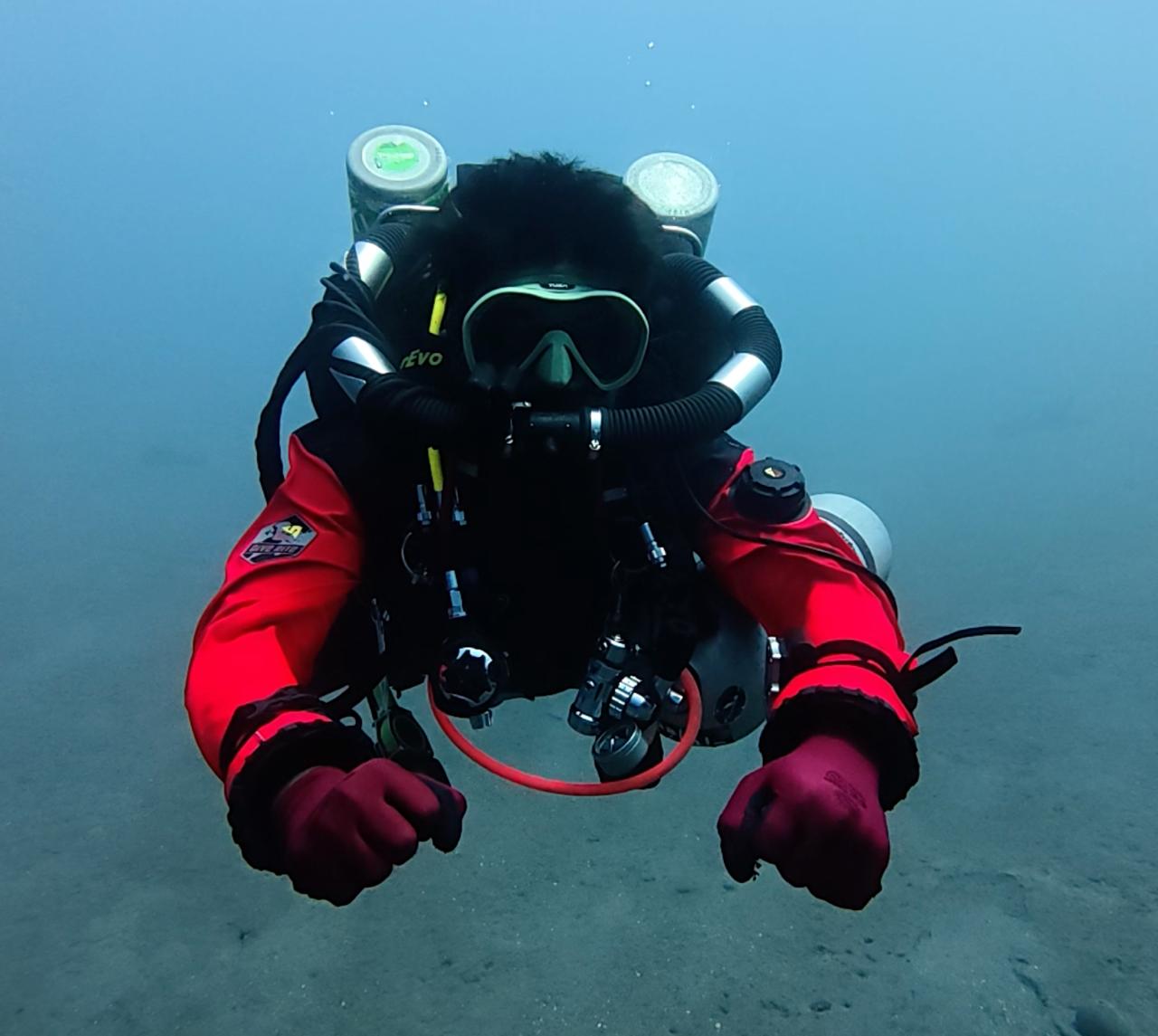
It sounds simple when you explain it like that. The machine itself is a little more complex: there’s oxygen sensors, a scrubber, manual add valves, counterlungs, electronics, oxygen and diluent supplies, and a whole concoction of procedures that need to become second nature. And that’s where the learning curve begins.
Everytime I take the CCR out for a spin, someone or the other asks me why I’m making my life more complicated. I asked myself the same thing at first, not going to lie. Why replace scuba with a machine that demands more knowledge and preparation? Well, a CCR offers some things that open-circuit scuba simply can’t.
The Silence. The Supply. The Sea.
The silence is the first thing that grabs you. On an open circuit, every breath produces bubbles and noise, and a lot of the reef’s ambient sounds are lost to it. On CCR, your exhaled gas stays in the loop and the constant stream of bubbles is gone. You can hear the environment around you, and marine life starts behaving differently.
Sometimes the fish let you become a part of their school. You notice how much they communicate and warn each other of approaching predators. Instead of making bubbles that keep everything at bay, you spend more time observing.
The second thing is the extended supply of gas. On an open circuit, you breathe your gas and it’s gone. On CCR, you’re recycling most of it, so you consume dramatically less, and longer dives don’t require enormous amounts of open-circuit gas. Although a CCR still requires appropriate planning, it becomes especially useful for extended range, a.k.a. technical diving and opens up a world of possibilities.
But there is an important distinction – CCR doesn’t make a dive safer just because you can stay underwater longer. It gives you different capabilities and those come with different responsibilities and training.
Is it hard? In the beginning, of course!
The biggest difference wasn’t breathing from the machine. It was learning to trust the information the system was giving me while understanding that I was ultimately responsible for interpreting it. With CCR, you’re managing a breathing environment. You need to understand what is happening inside that loop.
What’s my oxygen partial pressure? Is it breathable? If not, what are my options? How much scrubber time have I used? Is the loop volume correct? Are my sensors behaving as expected? And if something does fail, what is my bailout plan?
And that leads to the biggest lesson of all – you have to be ahead of the machine. You can’t wait for something to happen and then start thinking about the solution. Did I find that hard? Absolutely! I was used to diving with equipment that was relatively straightforward.
Neutral Buoyancy was the hard one. On an open circuit, you rise when you breathe in and sink when you breathe out. On CCR, the gas stays in the loop, so you can’t maintain buoyancy through breathing. You’re trying to accomplish true neutral buoyancy, and from what I’m seeing, it’s a life-long chase to perfection.
CCR made me slow down. I had to stop thinking of the rebreather as just another piece of equipment and start treating it as a life-support system.The first few dives involved a lot of thinking. Eventually though, something clicked – the procedures became familiar, the checks became routine, and a bunch of complicated components started to feel like one system.
That’s when CCR became fun, because you only enjoy what it allows when you stop fighting the equipment. Just breathing, quietly, noticing things you might have missed before – small movements, fish behaviour, the way the reef changes when you sit still.
It’s almost like becoming less noticeable underwater. To me, that was an incredible feeling.
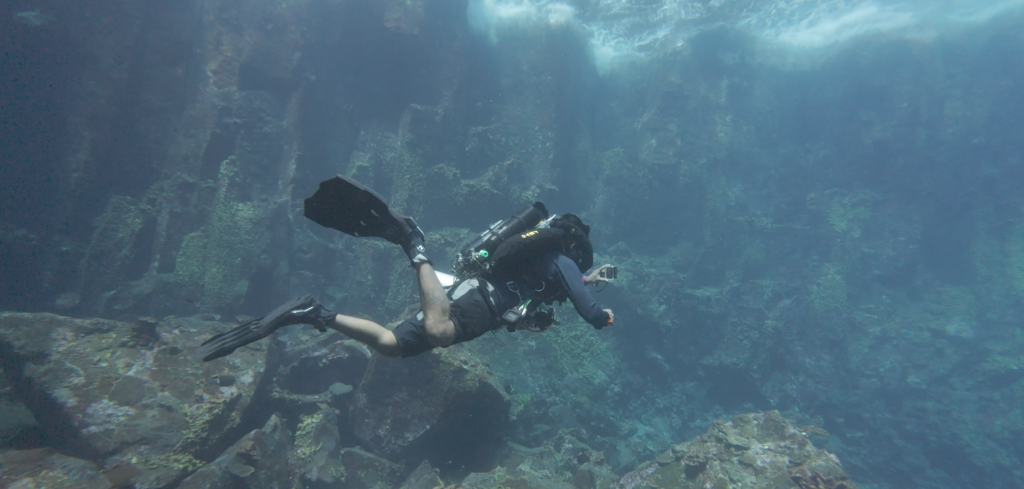
Is CCR for everyone?
My answer – not necessarily, and I don’t think that’s a bad thing. Some people love the simplicity of open-circuit. Some people don’t want to spend the time maintaining and checking a rebreather. Some dives simply don’t require one!
CCR is a tool, and I do think that more divers can find a place for it if they’re willing to learn the skills, because you need to be disciplined and comfortable with the procedures. You need to learn physiology, gas laws, understand the equipment you’re using, and above all, keep training and practising. It is a lot of work, but it is also a lot of fun!
So why do I dive CCR?
It’s not simply about diving deeper or longer, and it’s definitely not about having a complicated-looking piece of equipment strapped to me. It’s the thrill of XR diving and the challenge of learning something that seemed incredibly complex initially.
It’s about the experience, the discipline, the silence, getting closer to marine life, and enjoying all of that with my team. Perhaps most importantly, it’s made me a better diver.
It made me think more carefully about gas, physiology, equipment, planning and emergency procedures. And that knowledge has changed the way I approach every dive, even when I’m on an open circuit.
Looking back, I don’t think CCR replaced scuba for me. Scuba is where it all started. It’s still simple, fun and incredibly reliable. CCR just opened another door – longer, quieter dives, extended range, and a deeper understanding of what’s happening when we’re underwater.
I got into scuba because I wanted to explore the underwater world. I got into CCR because I wanted to understand that world, and my diving a little better. And I’m still learning, which, honestly, is probably one of the best things about diving.
There’s always another depth, another skill, another piece of equipment, another question… and another reason to get back in the water.
About the Author
Rishab is an XR Instructor, an Assistant Instructor Trainer, a CCR Diver with a side of Kayak, SUP & Windsurfing Instruction too! This mild obsession began with a TV show called “The Aquanauts”, and as it developed into a full-fledged love affair with the Ocean, it took him places — Pondicherry & Rameshwaram were critical stepping stones; but the Andamans are where he finally dropped anchor.
It sounds simple when you explain it like that. The machine itself is a little more complex: there’s oxygen sensors, a scrubber, manual add valves, counterlungs, electronics, oxygen and diluent supplies, and a whole concoction of procedures that need to become second nature. And that’s where the learning curve begins.
Everytime I take the CCR out for a spin, someone or the other asks me why I’m making my life more complicated. I asked myself the same thing at first, not going to lie. Why replace scuba with a machine that demands more knowledge and preparation? Well, a CCR offers some things that open-circuit scuba simply can’t.
The Silence. The Supply. The Sea.
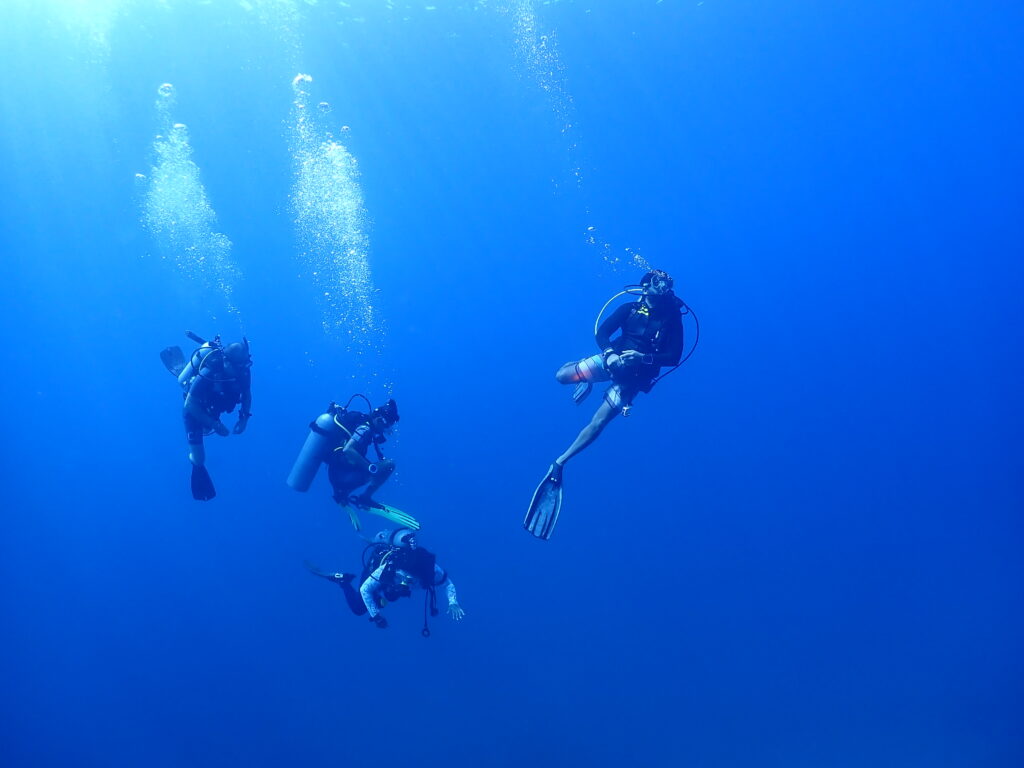
The silence is the first thing that grabs you. On an open circuit, every breath produces bubbles and noise, and a lot of the reef’s ambient sounds are lost to it. On CCR, your exhaled gas stays in the loop and the constant stream of bubbles is gone. You can hear the environment around you, and marine life starts behaving differently.
Sometimes the fish let you become a part of their school. You notice how much they communicate and warn each other of approaching predators. Instead of making bubbles that keep everything at bay, you spend more time observing.
The second thing is the extended supply of gas. On an open circuit, you breathe your gas and it’s gone. On CCR, you’re recycling most of it, so you consume dramatically less, and longer dives don’t require enormous amounts of open-circuit gas. Although a CCR still requires appropriate planning, it becomes especially useful for extended range, a.k.a. technical diving and opens up a world of possibilities.
But there is an important distinction – CCR doesn’t make a dive safer just because you can stay underwater longer. It gives you different capabilities and those come with different responsibilities and training.
Is it hard? In the beginning, of course!
The biggest difference wasn’t breathing from the machine. It was learning to trust the information the system was giving me while understanding that I was ultimately responsible for interpreting it. With CCR, you’re managing a breathing environment. You need to understand what is happening inside that loop.
What’s my oxygen partial pressure? Is it breathable? If not, what are my options? How much scrubber time have I used? Is the loop volume correct? Are my sensors behaving as expected? And if something does fail, what is my bailout plan?
And that leads to the biggest lesson of all – you have to be ahead of the machine. You can’t wait for something to happen and then start thinking about the solution. Did I find that hard? Absolutely! I was used to diving with equipment that was relatively straightforward.
Neutral Buoyancy was the hard one. On an open circuit, you rise when you breathe in and sink when you breathe out. On CCR, the gas stays in the loop, so you can’t maintain buoyancy through breathing. You’re trying to accomplish true neutral buoyancy, and from what I’m seeing, it’s a life-long chase to perfection.
CCR made me slow down. I had to stop thinking of the rebreather as just another piece of equipment and start treating it as a life-support system.The first few dives involved a lot of thinking. Eventually though, something clicked – the procedures became familiar, the checks became routine, and a bunch of complicated components started to feel like one system.
That’s when CCR became fun, because you only enjoy what it allows when you stop fighting the equipment. Just breathing, quietly, noticing things you might have missed before – small movements, fish behaviour, the way the reef changes when you sit still.
It’s almost like becoming less noticeable underwater. To me, that was an incredible feeling.
Is CCR for everyone?
My answer – not necessarily, and I don’t think that’s a bad thing. Some people love the simplicity of open-circuit. Some people don’t want to spend the time maintaining and checking a rebreather. Some dives simply don’t require one!
CCR is a tool, and I do think that more divers can find a place for it if they’re willing to learn the skills, because you need to be disciplined and comfortable with the procedures. You need to learn physiology, gas laws, understand the equipment you’re using, and above all, keep training and practising. It is a lot of work, but it is also a lot of fun!
So why do I dive CCR?
It’s not simply about diving deeper or longer, and it’s definitely not about having a complicated-looking piece of equipment strapped to me. It’s the thrill of XR diving and the challenge of learning something that seemed incredibly complex initially.
It’s about the experience, the discipline, the silence, getting closer to marine life, and enjoying all of that with my team. Perhaps most importantly, it’s made me a better diver.
It made me think more carefully about gas, physiology, equipment, planning and emergency procedures. And that knowledge has changed the way I approach every dive, even when I’m on an open circuit.
Looking back, I don’t think CCR replaced scuba for me. Scuba is where it all started. It’s still simple, fun and incredibly reliable. CCR just opened another door – longer, quieter dives, extended range, and a deeper understanding of what’s happening when we’re underwater.
I got into scuba because I wanted to explore the underwater world. I got into CCR because I wanted to understand that world, and my diving a little better. And I’m still learning, which, honestly, is probably one of the best things about diving.
There’s always another depth, another skill, another piece of equipment, another question… and another reason to get back in the water.
About the Author
Rishab is an XR Instructor, an Assistant Instructor Trainer, a CCR Diver with a side of Kayak, SUP & Windsurfing Instruction too! This mild obsession began with a TV show called “The Aquanauts”, and as it developed into a full-fledged love affair with the Ocean, it took him places — Pondicherry & Rameshwaram were critical stepping stones; but the Andamans are where he finally dropped anchor.